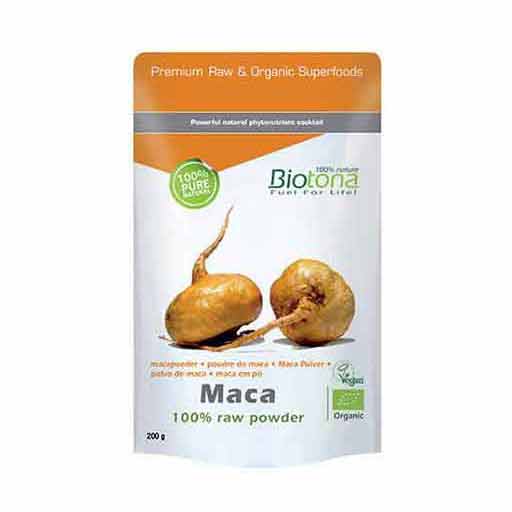


Biotona Maca
🌿 100% raw organic maca root powder — Lepidium meyenii from Peru
⚡ Natural adaptogen — supports physical and mental energy performance
🌾 13g protein / 20g fibre / 55g carbs per 100g — rich in phytonutrients
🌱 Certified organic — hand-harvested at high altitude in the Andes
🥤 Add to smoothies, lattes, porridge, yoghurt or savoury dishes



What is Maca Raw Powder by Biotona?
Biotona Bio Maca Raw is a 100% organic raw maca root powder derived from Lepidium meyenii — a remarkably resilient plant that grows at high altitude (3,800 to 4,500m) in the central Andes of Peru, on rocky soils and under extreme climatic conditions including intense UV radiation, frost, drought and thin air. This hostile environment is not a liability — it is precisely what stimulates the maca root to develop its extraordinary concentration of phytonutrients, adaptogens and bioactive compounds as a survival mechanism.
Maca has been cultivated and consumed by Andean populations for over 2,000 years. In Peruvian traditional medicine, it is considered a powerful adaptogen — a substance that helps the body adapt to physical, psychological and environmental stress — and has been valued traditionally for its ability to enhance physical performance, stamina, libido and fertility in both men and women. Modern scientific research has begun to validate several of these traditional uses, particularly in the areas of energy metabolism, hormonal balance, sexual health and mental clarity.
Biotona's maca is cultivated organically and harvested by hand after an 8-month growth period. After harvest, the roots are dried naturally in the high-altitude sun (a traditional preservation method that concentrates the bioactive compounds), then cleaned, selected, dehydrated and milled into a fine powder. This gentle "raw" production process preserves the enzymatic activity and full phytonutrient content of the fresh root — producing a product that is nutritionally closer to the whole food than conventionally processed maca powders.
The resulting powder is rich in fibre (20g/100g), plant protein (13g/100g), carbohydrates (55g/100g) and naturally occurring minerals and phytonutrients including glucosinolates, alkaloids (macamides and macaenes), sterols, polyphenols and a variety of essential minerals. The daily recommended dose is 1 tablespoon (approximately 10g) mixed into smoothies, lattes, yoghurt, porridge or any food preparation.
High altitude. Raw. Organic. The original Andean superfood.
| Brand | Biotona |
| Size | 200 gr |
How Maca Raw Powder by Biotona supports your objectives
⚡ Natural adaptogen for physical and mental performance Maca is classified as an adaptogen — a plant that helps the body maintain equilibrium under physical, cognitive and psychological stress without disturbing normal hormonal function. The adaptogenic action of maca is attributed primarily to its unique alkaloids (macamides and macaenes) and glucosinolates, which modulate the hypothalamic-pituitary-adrenal (HPA) axis — the central stress response system — without directly supplying exogenous hormones. This makes maca a hormone-balancing superfood rather than a hormonal supplement.
🏋️ Physical performance and stamina Maca has been studied for its effects on physical endurance and strength performance. Animal and human studies have shown improvements in exercise capacity, cycling performance and self-reported energy levels following regular maca supplementation. These effects are attributed to the synergistic action of maca's unique alkaloid profile alongside its high carbohydrate and mineral content, which provides both metabolic fuel and micronutrient support for energy production.
🌸 Hormonal balance and reproductive health The most extensively studied effect of maca in modern research is its influence on sexual health and hormonal balance. Multiple human clinical trials have demonstrated improvements in libido, sexual desire and reproductive markers in both men and women following regular maca supplementation. In postmenopausal women, maca has been associated with reductions in menopause-related symptoms (hot flushes, mood disturbances) without measurable changes in hormone levels — suggesting an indirect hypothalamic-modulating mechanism rather than direct hormonal activity.
🧠 Mental clarity, mood and stress resilience As an adaptogen, maca supports cognitive function and mood stability under stress. Research has associated regular maca consumption with improvements in perceived energy, mood, and mental focus, particularly in individuals experiencing fatigue or hormonal stress. The macamides — unique fatty acid derivatives found only in maca — appear to be particularly relevant to mood and memory support through their interaction with the endocannabinoid system.
🌾 Nutrient-dense whole food profile Unlike isolated supplements, Biotona Maca Raw is a whole food powder. Per 100g it provides 13g of plant protein (containing all essential amino acids), 20g of dietary fibre, 55g of complex carbohydrates and naturally occurring minerals including calcium, magnesium, phosphorus, potassium, iron, copper, manganese and zinc. This makes maca genuinely nutritious in its own right — not just a concentrated bioactive extract.
🎯 Goal guide
🏋️ Mass gain: add 1 tablespoon/day to smoothies or porridge. Adaptogenic support for high training loads.
🔥 Weight loss / cutting: add 1 tablespoon/day. Adaptogen for hormonal balance and energy during caloric restriction.
⚖️ Daily wellbeing: 1 tablespoon/day as a year-round nutritional ritual for energy, vitality and hormonal support.
Serving suggestion
Add 1 level tablespoon of Biotona Bio Maca Raw (approximately 10g) per day to your smoothie, shake, latte, yoghurt, porridge or savoury dish. Maca has a distinctive earthy, malty, slightly caramel-like flavour — it pairs naturally with chocolate, vanilla, banana, nut butters, cinnamon and warm spices. Start with a smaller dose (1 teaspoon) if you are new to maca, and increase gradually to 1 tablespoon per day over 1 to 2 weeks as your body adapts.
Limit daily consumption to 1 tablespoon (approximately 10g). Ensure a varied and balanced diet and a healthy lifestyle. Store in a cool, dry place away from light. Keep sealed.
Best times to enjoy it
🌅 In the morning (recommended) Adding maca to a morning smoothie or porridge provides an energising start to the day. The carbohydrate content provides sustained blood glucose support; the adaptogenic alkaloids begin modulating the stress response from early in the day.
🏋️ Before training A morning smoothie with maca before exercise combines the maca's adaptogenic and performance-supporting properties with the physical stimulus of training — the combination most likely to produce synergistic effects on stamina and recovery.
☕ As a latte or warm drink Maca dissolves well in warm (not boiling) liquids and adds a natural, malty sweetness that pairs beautifully with plant-based milks, cocoa, cinnamon and vanilla. A maca latte is one of the most popular daily rituals for maca users worldwide.
🍽️ In cooking Maca powder integrates seamlessly into baked goods (banana bread, muffins, waffles, pancakes), energy balls, overnight oats, guacamole and savoury dishes. The earthy flavour adds depth and complexity to both sweet and savoury preparations.
Daily protein target reminder
Maca Raw Powder is a superfood supplement, not a primary protein source. At 10g per tablespoon, each daily dose contributes approximately 1.3g of plant protein. For active individuals requiring complete daily protein from high-quality sources, current sports nutrition science recommends 1.6 to 2.2g of protein per kg of body weight per day.
| Body weight | Min. target (1.6g/kg) | Max. target (2.2g/kg) |
|---|---|---|
| 55 kg | 88g/day | 121g/day |
| 65 kg | 104g/day | 143g/day |
| 75 kg | 120g/day | 165g/day |
| 85 kg | 136g/day | 187g/day |
| 95 kg | 152g/day | 209g/day |
Goal-specific guidance
For athletes under high training load: Add 1 tablespoon of Maca Raw to your pre-workout or morning smoothie alongside a complete protein source. Maca's adaptogenic properties are most relevant in periods of high physical demand — preparation phases, competition seasons or high-volume training blocks — where accumulated fatigue, hormonal stress and performance plateau are most likely to occur.
For hormonal balance and wellbeing: Consistent daily use over a minimum of 6 to 8 weeks is the evidence-based protocol for maca's hormonal and adaptogenic effects. Short-term or occasional use does not produce the same outcomes as sustained daily supplementation. Maca is a whole-food superfood — its benefits accumulate gradually rather than producing acute effects.
🏅 Sport Nutrition "Did you know?"
Maca is one of the very few food plants in the world that evolved to thrive in one of the harshest environments on Earth — the altiplano of the Andes above 3,800 metres. At this altitude, UV radiation is 50% more intense than at sea level, oxygen levels are 40% lower, and temperatures fluctuate from 10°C during the day to below -15°C at night. Very few plant species can survive these conditions; maca not only survives but thrives, concentrating a unique suite of survival compounds (macamides, macaenes, glucosinolates, sterols) in its root. It is precisely these stress-response compounds — produced by the plant for its own survival — that are responsible for the adaptogenic effects that humans benefit from when consuming the root. In a very real sense, the extremity of the maca plant's environment is the source of its power.
Full ingredient list
Maca powder (Lepidium meyenii) (100%) from Peru. *Organically certified.
Key ingredient breakdown
| Active compound | Role |
|---|---|
| Macamides and macaenes (unique alkaloids) | Primary adaptogenic compounds; modulate HPA axis stress response; support mood, memory and libido |
| Glucosinolates | Secondary metabolites with adaptogenic and antioxidant properties; found in all cruciferous plants |
| Phytosterols (beta-sitosterol, campesterol) | Support hormonal balance; anti-inflammatory properties |
| Polyphenols | Antioxidant compounds protecting cells against oxidative stress |
| Plant protein (13g/100g) | Contains all essential amino acids; contributes to total daily protein intake |
| Dietary fibre (20g/100g) | Supports gut microbiome health and digestive regularity |
| Complex carbohydrates (55g/100g) | Natural energy substrate for physical and cognitive performance |
| Naturally occurring minerals | Iron, calcium, magnesium, phosphorus, potassium, copper, manganese, zinc |
Allergens and certifications
Allergens: No major allergens declared. Maca is a root vegetable from the Brassicaceae (cruciferous) family. Always refer to the product label for the most current allergen information.
Product characteristics:
- 100% single-ingredient — maca root powder only
- Certified organic (EU)
- Raw process — enzymatic activity and full phytonutrient content preserved
- Vegan and vegetarian
- Gluten-free
- Origin: Peru (Central Andes)
- Produced by Biotona — Keypharm Laboratories, Belgium
- Limit daily use to 1 tablespoon (approx. 10g)
Nutritional values per 100g
| Nutritional values | Per 100g |
|---|---|
| Energy | 1340 kJ / 319 kcal |
| Fat | 0.9g |
| of which saturates | 0.2g |
| Carbohydrates | 55g |
| of which sugars | 32g |
| Dietary fibre | 20g |
| Protein | 13g |
| Salt | 0.01g |
Per daily serving (1 tablespoon = ~10g)
| Nutritional values | Per 10g serving |
|---|---|
| Energy | 134 kJ / 32 kcal |
| Fat | 0.09g |
| Carbohydrates | 5.5g |
| of which sugars | 3.2g |
| Dietary fibre | 2g |
| Protein | 1.3g |
| Salt | <0.01g |
Bag duration guide
| Daily dose | Bag weight | Duration |
|---|---|---|
| 1 tablespoon (~10g/day) | 200g | 20 days (~3 weeks) |
Q1 — What does maca actually taste like and how do I mask it if needed? Maca has a distinctive earthy, malty and slightly caramel-like flavour with a hint of butterscotch — often described as reminiscent of malted milk or radish. Most people find the flavour pleasant and warming, particularly in hot drinks. It pairs naturally with chocolate, cocoa, vanilla, banana, peanut butter, cinnamon, dates and warm spices like cardamom. In smoothies with fruit or nut butters, the maca flavour is easily integrated. For those who find the taste too strong initially, starting with half a teaspoon in a fruit-forward smoothie and gradually increasing to a full tablespoon over 1 to 2 weeks makes the transition comfortable.
Q2 — Is maca safe for everyone? Maca is a whole food that has been consumed daily by Andean populations for millennia and is considered safe for most healthy adults at the recommended dose of 1 tablespoon per day. However, it should be used with caution by individuals with thyroid conditions — maca contains glucosinolates, which can interfere with thyroid function in individuals with iodine deficiency or pre-existing thyroid disorders. Pregnant and breastfeeding women should consult their physician before use, as the research on maca during pregnancy is insufficient to make clear safety recommendations.
Q3 — How long does it take to feel the effects of maca? Maca's adaptogenic effects are cumulative rather than acute. Most users report first noticing improved energy levels and reduced fatigue after 2 to 3 weeks of consistent daily use. Effects on libido and hormonal balance are typically more noticeable after 4 to 8 weeks of daily supplementation. Like all adaptogens, maca works gradually and systemically — it is not a stimulant that produces an immediately perceptible effect, but a whole-food supplement whose benefits deepen with consistent daily use over time.
Q4 — How long does one 200g bag last? At 1 tablespoon (approximately 10g) per day, the 200g bag provides approximately 20 daily servings — just under 3 weeks of use. For athletes who use maca daily as part of their nutritional routine, purchasing two bags at a time provides continuous supplementation for over 5 weeks without interruption. Maca is best used consistently over extended periods for maximum adaptogenic benefit.
Q5 — Can I cook and bake with maca powder? Yes. Maca is heat-stable at normal cooking and baking temperatures and integrates well into a wide range of preparations. It can be added to pancake batters, banana bread, muffins, energy balls, waffles, overnight oats, hot chocolate and even savoury dishes like guacamole. Baking does not significantly degrade maca's nutritional content, though very prolonged high-heat exposure (above 180°C for extended periods) may reduce some enzymatic activity. See Tab 7 for recipe inspiration directly from the Biotona team.
🍌 Recipe 1 — Maca blueberry banana bread
Time: 15 minutes preparation + 45 minutes baking
Ingredients (1 loaf — 8 to 10 slices):
- 3 very ripe bananas, mashed
- 2 whole eggs
- 1 tbsp (10g) Biotona Bio Maca Raw
- 150g rolled oats (blended to flour)
- 1 tsp baking powder
- 100g fresh or frozen blueberries
- 1 tsp vanilla extract
- A pinch of cinnamon
Instructions:
- Preheat oven to 175°C. Line a loaf tin with baking paper.
- Blend the rolled oats into flour in a food processor.
- In a large bowl, mash the bananas until smooth. Add eggs and vanilla. Mix well.
- Stir in oat flour, maca powder, baking powder and cinnamon until combined.
- Fold in blueberries gently.
- Pour into the tin and bake for 40 to 45 minutes until a skewer comes out clean.
- Cool for 15 minutes before slicing. The bananas provide natural sweetness — no added sugar needed.
Approximate macros per slice (1/10): ~120 kcal | ~20g carbs | ~2g fat | ~4g protein
☕ Recipe 2 — Hormone balancing maca latte
Time: 5 minutes
Ingredients (1 serving):
- 1 tsp (5g) Biotona Bio Maca Raw
- 250ml oat milk or almond milk
- 1 tsp raw honey or maple syrup (optional)
- A pinch of cinnamon
- A pinch of vanilla powder or vanilla extract
Instructions:
- Heat the plant-based milk in a small saucepan over medium heat until warm but not boiling.
- Add maca powder, cinnamon and vanilla. Whisk vigorously until frothy and fully dissolved.
- Pour into a mug and add honey or maple syrup if desired.
- Sprinkle a pinch of cinnamon on top and serve immediately.
- Enjoy in the morning as an energising alternative to coffee, or in the evening as a calming pre-sleep ritual.
Approximate macros per serving: ~85 kcal | ~12g carbs | ~2g fat | ~2g protein
🥤 Recipe 3 — Maca peanut butter energy smoothie
Time: 3 minutes
Ingredients (1 serving):
- 1 tbsp (10g) Biotona Bio Maca Raw
- 1 ripe banana
- 1 tbsp natural peanut butter
- 250ml oat milk
- 1 tsp raw cacao powder (optional)
- 3 to 4 ice cubes
Instructions:
- Add all ingredients to a blender.
- Blend on high for 20 to 25 seconds until smooth and creamy.
- Pour into a large glass and consume immediately.
- Ideal as a pre-workout energy smoothie or a nutritious breakfast on the go. The maca and peanut butter combination provides sustained energy from complex carbohydrates, healthy fats and plant protein.
Approximate macros per serving: ~320 kcal | ~40g carbs | ~12g fat | ~10g protein